
Free percussion practice app
Choose the rudiment. See the sticking. Build the hands. Control the tempo.
Rudiment Builder is a free browser-based trainer for the 40 PAS International Drum Rudiments. Pick a rudiment, read its sticking, watch the strokes light up in time, and practice it at one tempo, up a tempo ladder, or through an open–close–open path.
No account · No download · Works on phones, tablets, Chromebooks, and computers · Free forever
Diddles · PAS 6
Double Stroke Open Roll
Right-hand lead · sixteenth notes · two-beat cycle
- Accent
- Diddle
- Left hand
- Sounding now
What Rudiment Builder is
The named rudiments, with the practice built in
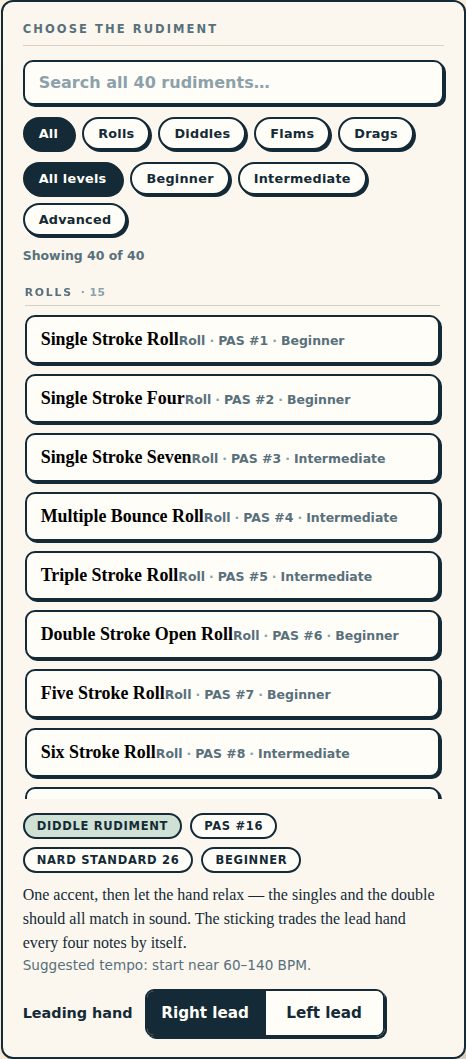
Rudiment Builder is a focused trainer for established, named rudiments. All 40 PAS International Drum Rudiments are here — rolls, diddles, flams, and drags — each one carrying its sticking, its accents, its grace notes, a short teaching note, and a suggested starting tempo.
It teaches the rudiments you already have to learn, rather than letting you invent new ones. There is no pattern editor and no notation software to fight: choose a name from the list, and the app supplies a correct sticking, an accurate loop, and a practice path to take it through.
Who it's for
Students, band directors, and studio teachers
Students
Learn what a rudiment is actually called, see exactly where the accents and diddles fall, and work it up from a comfortable tempo without guessing at the next step.
Band directors
Put any of the 40 on the board in a couple of taps, model it at a tempo the section can hold, and run the same rudiment with a right or left lead in front of the whole class.
Percussion instructors and private teachers
Set a starting tempo, a target, a step size, and the reps at each rung, then copy a link that opens that exact drill on the student's own device.
Choose it. Read it. Work it up.
Three panels, one rudiment between them
Key features
Built for the percussion classroom
- All 40 PAS International Drum Rudiments
- Search by name, filter by family and level
- PAS number and N.A.R.D. heritage on every rudiment
- A short teaching note and a suggested tempo range
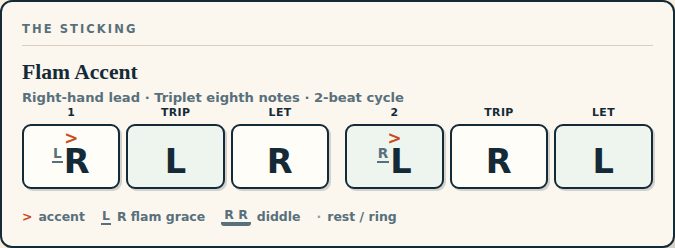
- Large R/L sticking cells on a counted grid
- Accents, grace notes, diddles, buzzes, and grouped strokes
- Right- or left-hand lead
- Current-stroke highlighting synchronized to the sound
- Right and left distinguished by pitch and stereo placement
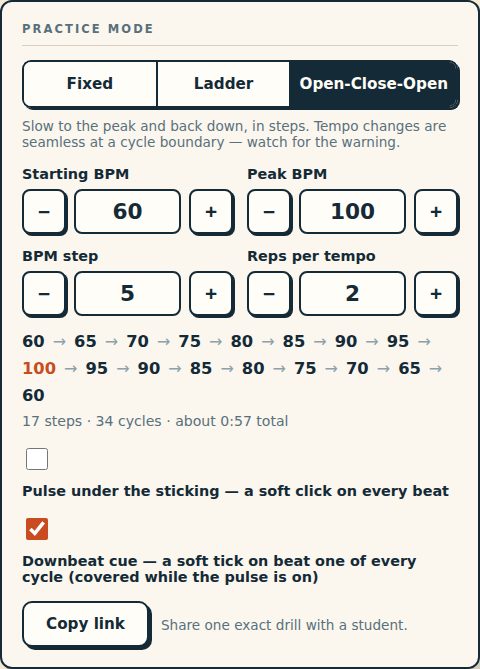
- Fixed-tempo, tempo-ladder, and open–close–open practice
- Starting tempo, target, step size, and reps per rung
- A four-beat count-in and a printed tempo path before you start
- Optional pulse under the sticking, or a downbeat-only cue
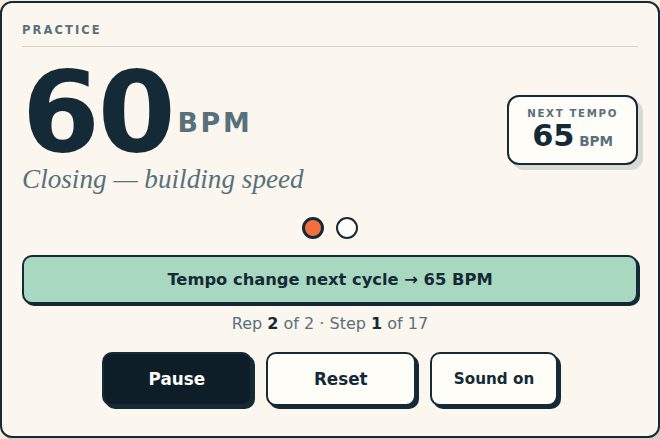
- Mute for silent, visual-only practice
- Copy a link that opens one exact drill
- Pause holds your place; Reset returns to the top
- Space starts and pauses, R resets
- Full-screen mode for a projector or classroom display
- Responsive layouts for phones, tablets, Chromebooks, and computers
Built for the band hall
Use Rudiment Builder to:
- Put any of the 40 rudiments on the board without hunting for a chart
- Show a student where the accent and the diddle actually fall
- Run the same rudiment leading with the weaker hand
- Set a slow tempo that a beginner can play cleanly, and hold it
- Work a rudiment up a tempo ladder with a fixed number of reps at each rung
- Run an open–close–open cycle to a peak tempo and back down the same steps
- Mute the sound and let students watch the sticking during a section rehearsal
- Send one exact drill home as a link, with no account to set up
Why it's different
A rudiment chart shows you the sticking and stops there.
A poster on the wall cannot play the rudiment. A metronome can hold a tempo but knows nothing about the pattern. A notation app will let you write anything — including a rudiment that is wrong.
-
Named rudiments only
The established catalog, with the names, families, and numbers students are tested on — not a blank pattern builder.
-
Sticking you can read across the room
Large R/L cells on a counted grid, with accents, diddles, flams, and drags marked without relying on color alone.
-
Playback that agrees with the page
The highlighted cell is the stroke you are hearing, scheduled on the audio clock so it stays honest over a long run.
-
Tempo work with rules you can see
Ladder and open–close–open print their whole path — every rung, the reps at each, and the total time — before you press Start.
-
Educational lineage on every rudiment
The PAS number and the N.A.R.D. Standard 26 heritage, so a student learns where the rudiment came from along with how to play it.
-
Free, and account-free
No paywall, no signup, no install. Open the URL on whatever device is in the room and practice.
Free, private, and easy to open
No account. No download. No paywall.
Rudiment Builder requires no account and no backend. Your settings stay in your own browser. Open it in a modern browser and start practicing.
Definitions follow the PAS 40 International Drum Rudiments (1984), rooted in the N.A.R.D. Standard 26 (1933). Some hybrid rudiment interpretations vary by published source and remain under educator proofing. Rudiment Builder is independent and is not affiliated with or endorsed by the Percussive Arts Society or N.A.R.D.
Ready to build the hands?
Pick a rudiment, set a tempo you can play cleanly, and let the app take it up from there.