Filter and it stays readable
Search or filter below the chart and the instruments you are looking at stay in color while the rest fade back. The axis never moves, so what you are comparing does not move either.
 Percussion AtlasBackwerd Rhythm Shop
Free instrument reference
Every instrument, from one spec.
Twenty-seven percussion instruments, each with its range, its bar counts, how its accidental row groups, what a drawing of it must never get wrong, and which real instrument the measurements came from.
Nothing is scored and nothing is assigned. No account, and no student data collected.
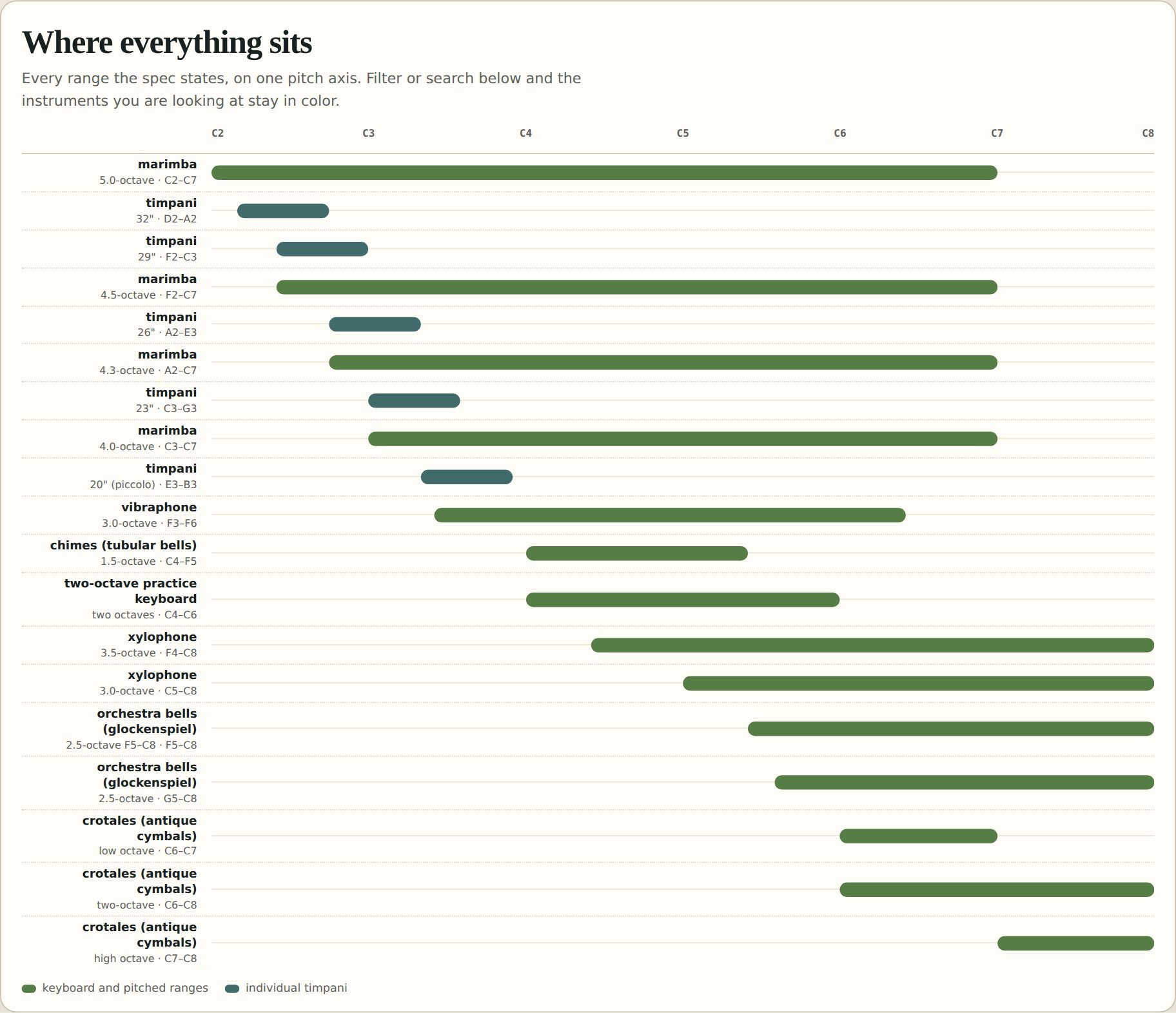
The view the spec never had
That is the question a percussion teacher actually asks, and until now the answer lived in a list of ranges you had to hold in your head two at a time. The range chart puts all of them on one fixed pitch axis, so the comparison is a glance rather than an exercise.
Is this passage inside a 4.3-octave marimba? Can the 26-inch drum reach that note? Which of the four timpani can play an A2? The chart answers all three the same way — by drawing the ranges over each other and letting them overlap where the instruments really do.
Search or filter below the chart and the instruments you are looking at stay in color while the rest fade back. The axis never moves, so what you are comparing does not move either.
A 4.0-octave marimba and a 5.0-octave marimba are two bars, not one, because they are two instruments to anybody deciding what a part needs. The same is true of the four timpani and both glockenspiel sizes.
What a lookup gives you
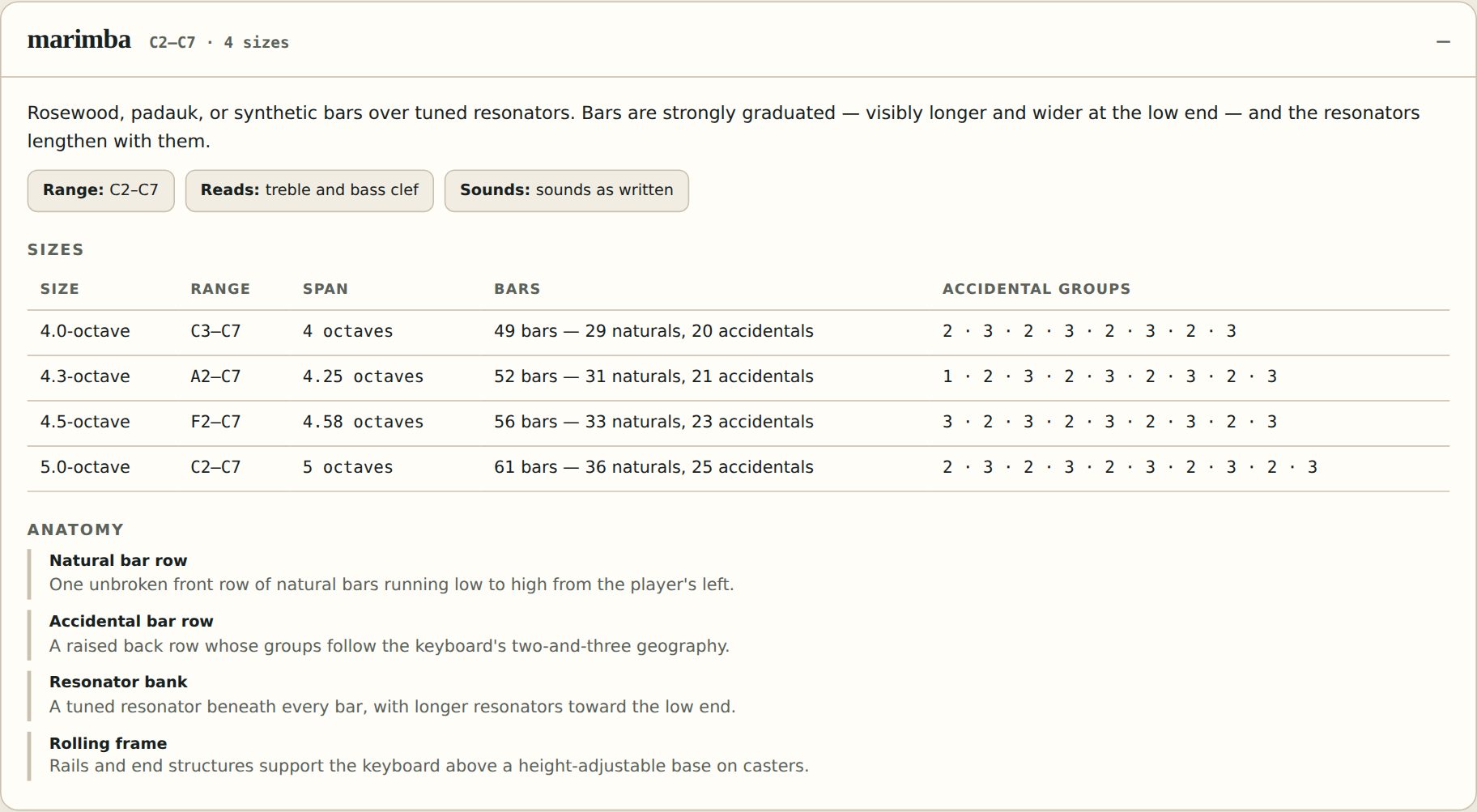
A 4.3-octave marimba has fifty-two bars — thirty-one naturals and twenty-one accidentals — because that is what its stated range works out to. Every count on the page is derived from the range rather than typed next to it.
Each instrument separates the structure that cannot change from the detail that can. Naturals stay continuous and accidentals never occupy the E–F or B–C gaps; bar material and frame hardware are free to differ by maker.
Cited models are measurements, with the date they were checked. They are there to say where a number came from, not to recommend a make — the drawings stay brand-neutral on purpose.
Correct by construction
The forty schematics are not illustrations of instruments. Each one is generated from the stated range, so a 4.3-octave marimba has fifty-two bars in the picture because it has fifty-two bars in the data. A drawing cannot drift away from the fact it illustrates, because it was never drawn by hand in the first place.
The same is true of the whole page. Atlas holds no musical content of its own: every range, bar count, anatomy statement and cited model is derived from the instrument spec the shop's artwork and practice apps are built against. When the spec changes, Atlas is rebuilt from it and its own test suite refuses the build if a single number no longer re-derives.
What it is not
Atlas asks no questions and keeps no result. It is the reference the shop's practice apps drill against — the place to look something up before or after the practicing, not a thing to practice on.
No account, no sign-in, and no student data collected. Open the page and it is already working.
Every instrument is an expandable section the keyboard can reach and open, and each schematic carries the spec's own description of what it shows as its alt text.
Twenty-seven of them, every stated range on one axis, and a schematic for each that was drawn from the numbers.