
Free 3/8 rhythm trainer
Eight Time
The eighth note takes the beat.
Read and count 3/8 — the meter where the beat is an eighth note and every question is an honest whole bar — through guided practice and short challenges.
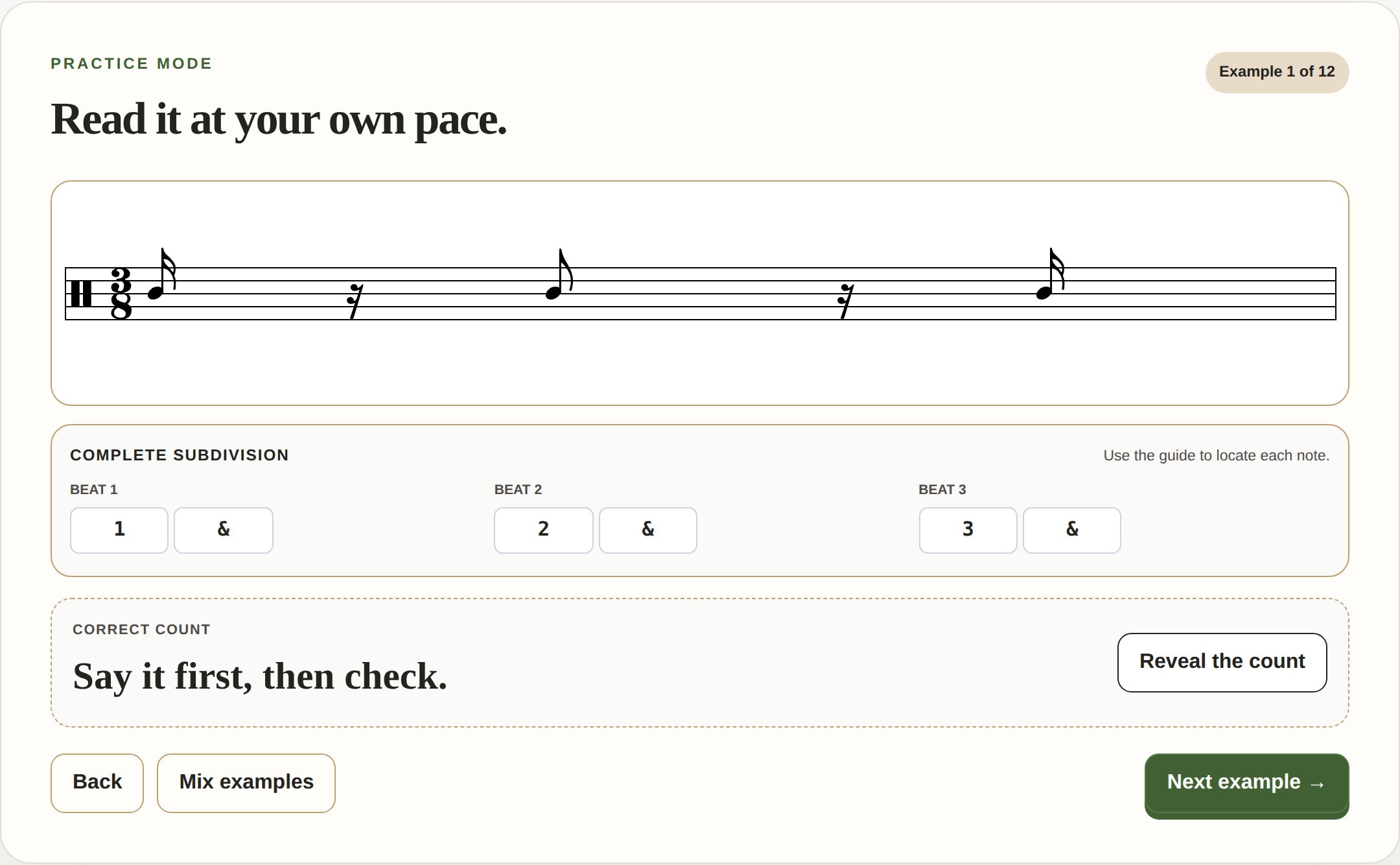
Beat 1
Beat 2
Beat 3
What it is
The 3/8 half of a counting trainer you may already know
Eight Time is a free rhythm-counting trainer for phones, tablets, and computers. It reads one meter, 3/8, and teaches the reading skill that meter actually asks for: the eighth note is the beat, each beat splits into two sixteenth positions, and a bar beams across the whole measure with the secondary beam broken at each beat — the way engraved 3/8 prints.
It began inside its sibling app, Count It, and split out in August 2026 when the eighth-note beat earned a home of its own. Every rhythm comes from the same verified catalog the split carried over, so the notation, the subdivision guide, the correct count, and the explanation all describe the same thing.
- Choose Practice or Challenge mode.
- Read a whole 3/8 bar — every question is one honest measure.
- Say the count out loud before you check it.
- Use the feedback to repeat, improve, and build fluency.
See it in action
Real notation, live in the browser
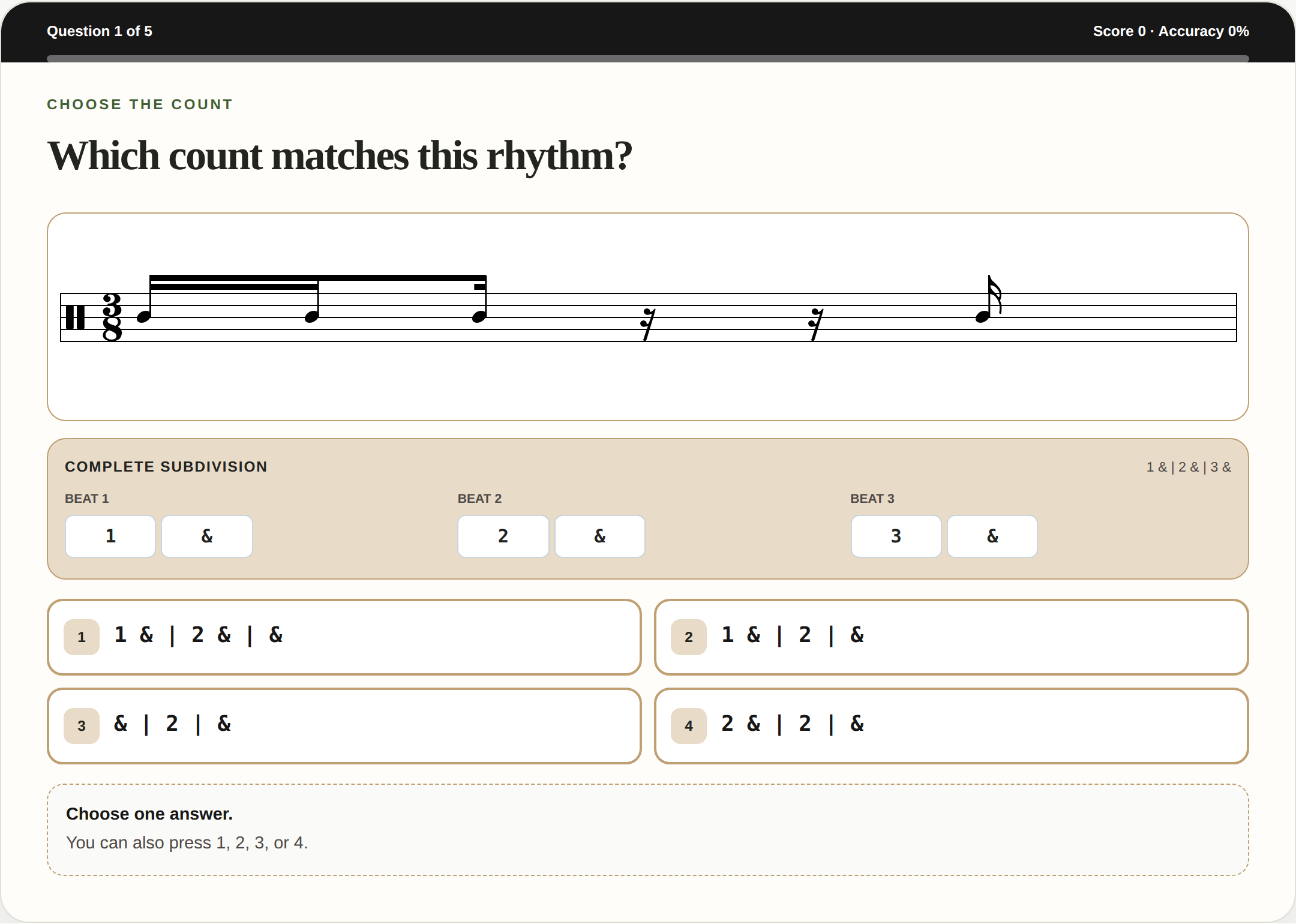
Practice and Challenge
Build it low-pressure. Then check it.
Guided, repeatable skill-building at your own pace — untimed and unscored, so a wrong guess costs nothing.
- Read the rendered bar and say the answer before revealing it
- Show or hide the complete 1 & subdivision guide
- Sounding positions highlight inside that guide
- Reveal the verified count and a short explanation
- Move back and forward, or mix the examples into a new order
A short check on fluency and accuracy — long enough to mean something, short enough to retry immediately.
- Unique choices, exactly one correct, answered by click or by number key
- Immediate feedback with the correct answer revealed after an error
- Wrong answers name the misconception: an omitted sound, an added sound, a shifted position, or the wrong beat number
- Running score and accuracy, then a result card
- Retry the same set or start a newly randomized one
- No timer, no lives, no leaderboard, no penalty for trying again
Four rhythms, always in play
The whole vocabulary of a beat that splits in two
An eighth-note beat can only be sounded, split, half-sounded at the front, or half-sounded at the back — so the catalog is four rhythms, and every round draws on all of them. There is no level ladder here; the list is short because the meter is, not because it is unfinished.
-
Eighth note
The whole beat sounds. Counted 1.
-
Two sixteenths
Both halves of the beat sound. Counted 1 &.
-
Sixteenth, then rest
Only the front half sounds. Counted 1.
-
Rest, then sixteenth
Only the back half sounds. Counted &.
Key features
Built for the band hall and the practice room
One mode to learn in and one to check in, sharing the same verified rhythms so nothing changes between them.
A single 3/8 beat is a third of a measure, and a stave cannot draw a third of a bar honestly — so every question is a complete measure.
Show the whole 1 & 2 & 3 & grid under every bar, or hide it once students can hold it in their heads.
Bars beam across the whole measure with the secondary beam broken at each beat, from a reviewed engraving baseline — matching the Theory Reference poster.
Every control is a real button, tab, radio, or select with a visible focus ring.
A 3/8 assignment link written while the meter lived inside Count It runs here unchanged and generates the identical questions.
Guide preference and personal bests are saved on the device. Nothing is uploaded.
Open the URL and start counting. No download, no install, no purchase, no student roster.
Phone, tablet, Chromebook, desktop — and readable on the projector in the band hall.
Who it’s for
Students, classrooms, and independent practice
Meeting a meter where the bottom number finally changes what the beat is, not just how many there are.
Reinforcing rhythm-reading fluency in the meter marches and solos actually use.
Looking for a quick classroom or lesson activity that projects cleanly and needs no setup.
Who want focused, repeatable practice without an account or a subscription.
Privacy, accessibility, and devices
Your practice stays on the device
Preferences and personal bests live in local browser storage. No name, no email, no account — clearing your browser data resets them. Nothing you play is sent anywhere.
Correct and incorrect states are carried by text and structure, not color alone. Feedback is announced through a live status region, and the notation and subdivision guide carry descriptive labels.
Touch-friendly controls and layouts verified on phone, tablet, and desktop, with no audio-only step anywhere in the app.
For teachers
Assign a round with one link
A link can pin the rhythms, the subdivision-guide policy, the feedback timing, the question count, the pass mark and a seed — post it in Google Classroom or Canvas and every student gets the same questions under the same conditions. The result card reports those conditions, the rhythms that were missed, and a verification code beside the score.
The three 3/8 steps of Rhythms in Three — 3/4 and 3/8 open here, with the same rhythms and seeds the meter carried before the split; the 3/4 half assigns in Count It, and pairing the two capstone steps is the whole point of the design.
Ready for a bar of three?
Open Eight Time — free, no signup. Need the details? The operating guide covers both modes, the guide policy, and every control.